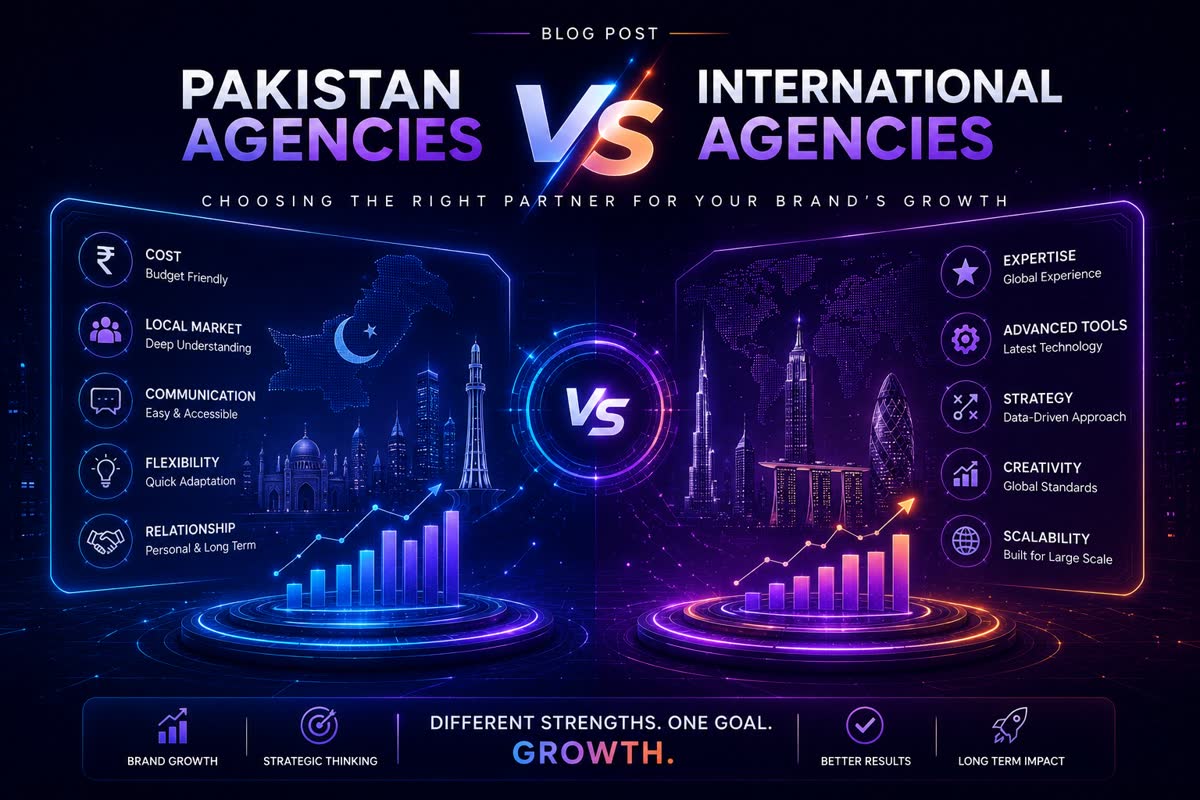
The myth: "global beats local"
Most Pakistani brand founders we talk to share the same assumption. "We need a global agency to compete globally." It's a real instinct, and it comes from a real place. Global agencies have polished decks, offices in Dubai or Manhattan, and case studies with Fortune 500 logos. The pitch deck is impeccable, the strategist is articulate, the dinner is at Nobu.
The mistake is assuming the polish maps to outcomes. It often doesn't. Look at the work product, not the brand of the agency.
What global agencies actually deliver
Let's be fair to them. Global agencies do three things very well.
Process and discipline. They've run a thousand campaigns and have systems for everything — brand briefs, creative review, weekly reporting templates, account governance. You'll never wonder what stage of the process you're in.
Brand-level thinking. They've been in the room for huge strategic decisions for billion-dollar businesses. They know how to talk to a CEO about positioning and category creation, not just ad units.
Senior strategic minds. The founders, partners, and creative directors who pitch you are sharp. They've seen more than you have. They can articulate the work in a way that makes you feel sophisticated for hiring them.
What they often don't deliver
This is where it gets uncomfortable.
The senior team you met in the pitch doesn't do the work. What actually executes your account is usually a mid-level account manager you've never spoken to, plus a junior creative team. The names on the proposal are the closers, not the doers. By the second month, the founder you fell in love with in the pitch is in a different city pitching someone else.
Local context is thin. A senior Brand Strategist sitting in London is advising on TikTok Pakistan trends without using TikTok Pakistan. The reels they approve are technically polished and contextually wrong. You'll see a stock-library mood board with white couples in a New York apartment proposed as a "premium Pakistani" aesthetic.
Speed is glacial. A simple ad concept revision takes 4 weeks because of layers of internal review. By the time the new creative ships, the trend it was chasing has moved on. In a market where Meta accounts need new creative every 14 days to avoid fatigue, this is a structural problem.
Skin in the game is missing. They're optimising their retainer, not your ROAS. If your campaigns underperform, the response is a longer report, not faster iteration. The contract makes it almost impossible for you to leave inside the first 6-12 months.
What local studios get right
The advantages here are not just "we're cheaper." Cheaper without quality isn't a win.
You talk to the people doing the work. The strategist you meet in the pitch is the strategist running your weekly review. The creative director is shipping the ads. No account manager middle layer translating your feedback into someone else's task list.
You move at Pakistani speed. Ad concepts in 48 hours. Creative iteration weekly. Trend response in days. This isn't a luxury — it's table stakes if you want to scale Meta accounts in 2026.
They live in your content environment. Your strategist knows the difference between Karachi TikTok and Lahore TikTok because they consume both. The reference they pull when pitching a creative concept is something the audience will actually recognise.
Pricing fits your unit economics. A USD 20K/month retainer might be 10% of your MRR. Local studios typically charge one-fifth to one-third of that for comparable senior work. The remaining 7-8% of MRR goes into the ad spend, where it actually buys you customers.
The hidden cost of remote-only partnerships
Even if you ignore everything above, the time-zone math doesn't work.
Karachi to London is a 4-5 hour gap. New York is 9-10. The accumulated cost of asynchronous back-and-forth across a week — clarifying briefs, approving creative, debugging tracking, reviewing reports — is easily 4-6 hours of senior time per week. That's an entire half-day, gone, every week, because messages sit in inboxes for half a day before getting a response.
An in-person studio handles the same conversations in a 30-minute standup. Over a quarter, you've recovered something like 50-70 hours of strategic attention to your business.
And when something breaks at 9am Karachi time — tracking pixel firing wrong, a campaign over-spending, an ad set rejected — your London agency is asleep. By the time they're awake, you've already lost the day.
When global is the right call
We don't think global agencies are wrong. There are genuine cases:
- You're expanding into US or EU markets and the local agency genuinely understands that audience — better than your Pakistani-context agency could.
- You need brand-name credibility for your board. Some boards expect a global agency name in the deck. If that's the political reality, fine.
- You're spending USD 50K+/month. At that scale, global agencies offer infrastructure (legal, compliance, multi-market coordination) that local studios can't match.
- You want a co-creative partnership with a specific agency's brand DNA. If you specifically want a Wieden+Kennedy or R/GA-shaped collaboration, that's not replaceable.
For most Pakistani brands spending USD 1K-15K/month on agency fees, local studios win on every dimension that actually matters to outcomes.
How to evaluate a local studio (without getting burned)
Most agencies in Pakistan are not Zyniq. Some are good, many are not. Here's a short list of questions to filter on:
- Who specifically is doing the work? Get names. The strategist, the creative director, the ads manager. Insist on speaking with them in the pitch, not just the founder.
- What's your reporting cadence? Anything less than weekly is dodging accountability. A real partner shows you data every Friday.
- What's your contract structure? If they require 12-month lock-ins, walk away. The good ones earn the renewal every month.
- Show me a live dashboard from a current client. With PII masked. Real-time data they can show you proves transparency — not screenshots of pitch decks.
- What channel mix did you recommend for client X and why? Vague answers are a bullshit detector. Real answers will be specific and will contradict across clients. If every client gets the same recommendation, you're getting templated work.
- Walk me through a campaign that didn't work. Every honest agency has these. If they can't think of one, they're either lying or new.
It's about fit, not nationality
Some Pakistani agencies are world-class. Some global agencies are mediocre. The category is meaningless — what matters is whether the specific team you'd be working with is good.
Pick on the answers to the questions above, not the address on the business card.
Frequently asked questions
Are international agencies better than Pakistani agencies?
Not inherently. Global agencies bring process and polish; strong local studios bring market fluency, timezone overlap, and direct accountability. What matters is the specific team's work product, not the nationality on the business card.
When should a Pakistani brand hire a global agency?
When you're scaling into Western markets at large budgets, need a single global brand system across regions, or require a specialised capability no local team has. For most brands spending USD 1,000-15,000 per month on agency fees, a strong local studio wins on the dimensions that drive outcomes.
How do I choose a good local agency in Pakistan?
Filter on whether they tie their work to numbers, who actually does the work day to day, how they report, and whether they'll push back on a bad idea. You can see how we structure that across our services.