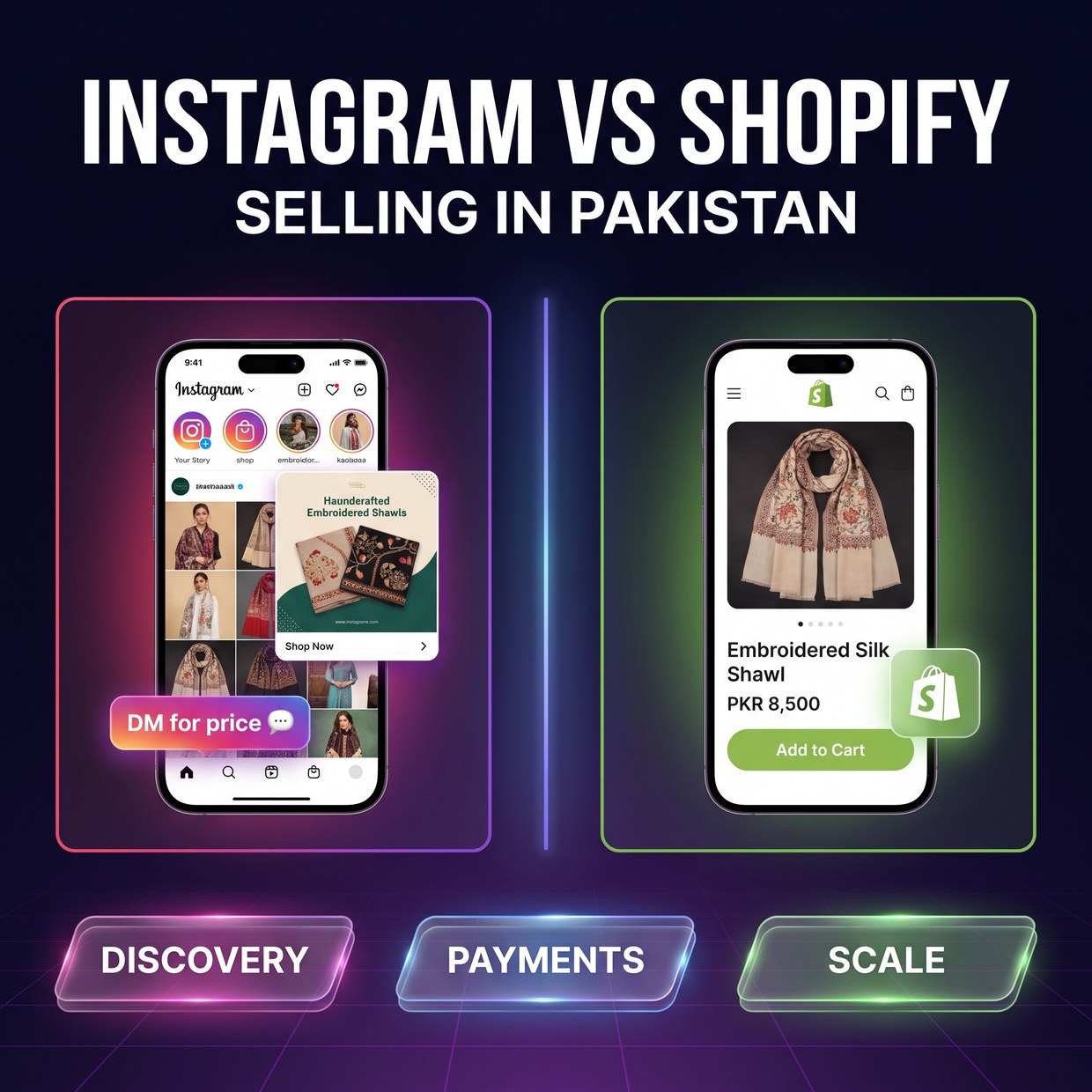
The short answer
Start on Instagram, graduate to Shopify, then run both together. Instagram is the best place in Pakistan to be discovered, build trust, and test what sells — at zero cost. But once orders are steady and DMs become a mess of “price?”, “available?”, and “sent the screenshot”, a Shopify store gives you a clean checkout, real inventory, and room to scale. It's rarely Instagram or Shopify — the winning Pakistani brands use Instagram for reach, WhatsApp to close, and a store for frictionless ordering.
What each one actually is
Instagram selling means running your shop inside the app — posts, Reels, and DMs do the selling, usually with cash on delivery. There's no website; the customer sees a product, messages you, and you confirm the order by chat. Shopify is a dedicated online store — your own web address, product pages, a cart, and a checkout that takes payment and records the order automatically. One lives entirely on social media; the other is a proper storefront you own. Most Pakistani sellers begin with the first and the question is when, not whether, to add the second.
Why Instagram wins at the start
For a new brand with no budget and no audience, Instagram is unbeatable. It's free, everyone's already there, and the discovery is built in — a single Reel can put your product in front of thousands of strangers without spending a rupee. You can launch in an afternoon, test whether people actually want what you're selling, and build trust through comments, Stories, and replies before you invest in anything. For validating a product idea in Pakistan, nothing beats it. The catch is that everything that makes it easy to start also makes it hard to scale.
Where Instagram-only starts to hurt
The DM model quietly breaks once you're busy. You retype the same price and stock answers fifty times a day, orders get lost between chats, you lose track of who has paid and who hasn't, and a customer who messages at midnight is gone by morning if no one replies. There's no cart, no automatic record, no clean way to show a full catalog, and no real product page to send ads to. None of this matters at five orders a week — at fifty, it's costing you money and sanity. That pain is the signal, not a failure.
What Shopify adds
Shopify turns the chaos into a system. Customers browse your full catalog, add to cart, and check out on their own — no waiting for a reply. Every order is recorded with the customer's details and address, inventory updates itself, and you get a real product page you can point ads and links to. It looks more professional, which matters when someone is deciding whether to trust you with advance payment. In short, Shopify handles the selling and order management so you can stop being a human order-taking machine and focus on growth.
The payment reality in Pakistan
Shopify works in Pakistan — just not with Shopify Payments. Shopify's own built-in payment processor isn't available here, which scares some people off unnecessarily. The solution is simple: connect a local payment gateway — providers such as Safepay or PayFast — to accept cards and wallets, and keep cash on delivery, which most Pakistani shoppers still prefer. So your store can take online payment and COD. The gateway charges a transaction fee, but the lack of Shopify Payments is a setup detail, not a dealbreaker — thousands of Pakistani stores run exactly this way.
Honest cost comparison
Instagram is free to run; Shopify is a modest, real monthly cost. Selling on Instagram costs nothing but your time (and ad spend if you choose to run ads). Shopify charges a monthly subscription in US dollars — its Basic plan is the usual starting point — plus payment-gateway transaction fees, and often a one-time investment in a good theme and setup or an agency to build it. For a brand with steady orders, that cost is small next to the time it saves and the sales it unlocks. For a brand doing a handful of orders a week, it's an expense you don't need yet. Match the tool to your volume.
Trust: the deciding factor in Pakistan
Pakistani buyers are cautious with online payment, and both channels have to earn trust differently. On Instagram, trust comes from your follower count, real customer reviews in Stories and comments, and how fast and human your replies are. On Shopify, trust comes from a clean, professional store, clear return and delivery policies, visible contact details, and offering COD so the customer isn't risking money upfront. The brands that win combine them: Instagram proves you're real and popular, and a polished store plus COD removes the fear at the final step.
When to graduate — the real signals
Add a Shopify store when order management, not demand, becomes your bottleneck. The clear signs: you're missing or mixing up orders, spending your whole day answering the same DMs, losing track of payments, or you simply can't keep up with the volume. Other good reasons are wanting to run proper ads to a real product page, selling a catalog too big for Stories, or needing to look more established to land bigger customers. If you're still getting a few orders a week and replies are easy, stay on Instagram — adding a store too early is just a cost with no payoff.
The setup most Pakistani brands should aim for
You don't have to pick a side. The strongest ecommerce setup in Pakistan uses each tool for what it's best at:
- Instagram for discovery. Reels and posts bring new people in — your top of funnel.
- WhatsApp to answer and close. Questions, objections, and confirmations happen in chat, where Pakistani buyers are comfortable.
- Shopify for the checkout. Send ready buyers to a clean product page with COD and online payment, so the order is placed and recorded cleanly.
- Reviews everywhere. Customer proof on Instagram and on the store removes the trust barrier at every step.
That's the same reach-trust-checkout thinking we covered in our WhatsApp marketing guide — the channels reinforce each other instead of competing.
The bottom line
Instagram vs Shopify isn't really a fight — it's a sequence. Start on Instagram, where it's free to be discovered and test what sells. Graduate to Shopify when DMs start costing you orders, using a local gateway and COD to handle payments the Pakistani way. Then run both, with WhatsApp in the middle to close. Get that flow right and you stop losing sales to a cluttered inbox and start scaling. If you want help building the store, wiring up a local payment gateway, or designing the whole funnel, that's exactly what our website & store design and performance marketing services do — built for the Pakistani market, end to end.
Frequently asked questions
Is Instagram or Shopify better for selling in Pakistan?
It depends on your stage. Instagram is better for starting out, testing products, and building an audience with zero cost. Shopify is better once you have steady orders and want a professional store, your own checkout, and the ability to scale without drowning in DMs. Most successful Pakistani brands start on Instagram and add a Shopify store once demand is proven, then run both together.
Can I accept online payments on Shopify in Pakistan?
Yes, but not through Shopify Payments, which isn't available in Pakistan. You connect a local payment gateway — options include providers like Safepay and PayFast — to take card and wallet payments, and you can also offer cash on delivery, which most Pakistani shoppers still prefer. Lacking Shopify Payments is not a blocker; you just use a local gateway plus COD.
How much does a Shopify store cost in Pakistan?
Shopify charges a monthly subscription in US dollars (its Basic plan is the usual starting point), plus transaction fees through your payment gateway. On top of that you may invest once in a proper theme and setup, or pay an agency to design and configure the store. For a small brand the ongoing cost is modest relative to the professionalism and scale it unlocks — but it is a real recurring cost Instagram selling doesn't have.
Do I still need Instagram if I have a Shopify store?
Yes. Instagram is where Pakistani customers discover you, build trust, and ask questions; Shopify is where the order is placed cleanly. They do different jobs. A store with no social presence gets little traffic, and a thriving Instagram with no store caps how much you can scale. The strongest setup uses Instagram and WhatsApp for reach and trust, and Shopify for a frictionless checkout.
When should I move from Instagram DMs to a Shopify store?
Move when DMs start costing you sales — when you're missing orders, repeating prices and stock all day, losing track of who paid, or can't handle the volume. Other good signals are wanting to look more professional, run proper ads to a real product page, or sell a growing catalog. If you only get a few orders a week, Instagram alone is fine; once order management becomes the bottleneck, it's time for a store.